
Some yacht builders are ahead of others when it comes to sustainability ideas. Greenline Yachts in Fort Lauderdale, Fla., has been building hybrid-drive boats since 2008, using diesels and electric motors for propulsion, with solar cells for passive recharging at anchor. Azimut Yachts in Italy has a Seadeck series of hybrid motoryachts that’s expected to reduce carbon-dioxide emissions by 40% over a year of average use, including cruising and time spent at anchor.
Also in the mix now is Italy’s Sanlorenzo Yachts, whose 50Steel is scheduled to launch in 2024. The 164-footer will carry an array of methanol fuel cells that will power all on-board systems — essentially, everything except propulsion. The client for this innovative build is Massimo Perotti, Sanlorenzo’s CEO.
The idea of using methanol fuel cells may be new in yachting circles, but it’s not new on the world’s waters. The shipping industry has also been working to replace hydrocarbon fuels with biofuels produced from sustainable feedstocks (which means organic materials that can be used as fuel or converted into fuel). Methanol is a source of relatively clean energy. According to the U.S. Department of Energy, methanol is fairly cheap to produce relative to other alternative fuels, is less flammable than gasoline, and can be produced from a variety of organic feedstocks.
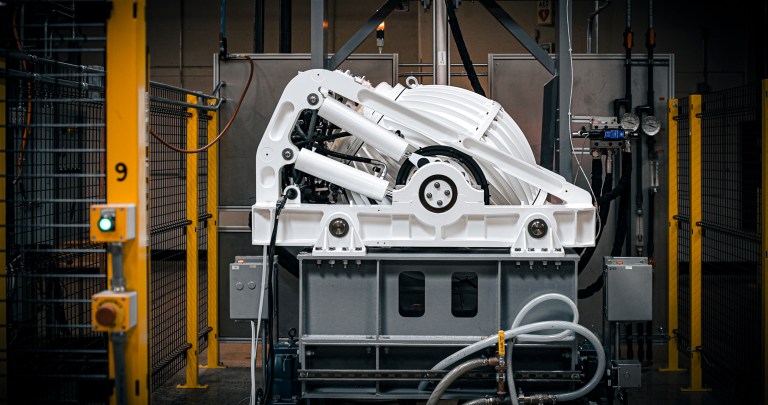
 Photo courtesy of METSTRADE
In a fuel cell, the methanol isn’t burned, but is instead electrolyzed to produce electricity. “It’s also one of the most readily available biofuels on the market, supplied in around 100 ports,” according to an engineer for Sanlorenzo.
Energy Without Ignition
Fuel cells create electricity through galvanic action, similar to the way a battery works, but instead of storing and discharging electrons, a fuel cell generates electron flow from a fuel, usually hydrogen. Like a battery, fuel cells have an anode and a cathode, separated by a polymer electrolyte membrane (PEM) similar to a thin piece of plastic wrap. When hydrogen is introduced to the anode side, a catalyst (generally a platinum coating on the anode) encourages the hydrogen atoms to split into protons and electrons. The PEM allows the protons to pass through to the cathode, but the electrons must travel through a wire from one side of the cell to the other. En route, they supply electricity to whatever appliances are in the circuit.
Once the electrons reach the cathode, they rejoin their protons, and combine with oxygen from the atmosphere to form water molecules. Thus, water is the only byproduct of a fuel cell, making it a clean source of power.
Where does a yacht owner get hydrogen? With the right technology, it can be electrolyzed from water. Or it can come from methanol. A reformer fuel cell, like those that Siemens Energy designed for Sanlorenzo, separates hydrogen from the other components of methanol, which are carbon and oxygen. Only hydrogen ions will pass through the fuel cell. The carbon and oxygen are discharged as carbon dioxide — which means this type of fuel cell isn’t as clean as one using pure hydrogen. However, the volume of carbon dioxide produced is much less than a fossil-fuel generator would create to make the same amount of electricity.
 PHOTO: CHARLES PLUEDDEMAN
“The reformer transforms methanol into hydrogen at the same time as the fuel cell is producing energy,” the Sanlorenzo engineer said. “This avoids having free — and explosive — hydrogen within the boat. The hydrogen is already in the fuel cell component.”
Some reformer fuel cells operate at high temperatures; some use steam to break down the methanol. But the modules for Sanlorenzo, built by Advent Technologies, operate at normal pressure and only slightly higher-than-ambient temperature.
At press time, the system was undergoing a Lloyds Register risk analysis to certify the installation.
Recycled Water
Sanlorenzo’s fuel-cell system will consist of 20 modules, generating 100 kW in total. This will be enough electricity to cover the 50Steel’s energy needs, according to the company engineer: “The energy produced by the cells isn’t stored, but used immediately. There are lithium-ion batteries on board with a capacity of around 600 kilowatt-hours, but they are used only to buffer peak energy demands.”
The 50Steel will carry 1,320 gallons of methanol, enough for about a week of full-load operation when mixed with distilled water at a 60-40 ratio. Water is a necessary component of the fuel that feeds a reformer fuel cell. Both the water and the methanol must be completely clean, because any contamination will degrade the performance of the fuel cell and vastly shorten its life. The water vapor that the reformer produces will pass through a condenser, which will allow it to be reused in the fuel cell. That means that zero waste will be discharged overboard.
Unlike hydrogen, which is stored at up to 10,000 psi of pressure, liquid methanol is carried safely at atmospheric pressure in conventional tanks. “Although it’s a fuel that can be likened to petrol or diesel,” the Sanlorenzo engineer said, “it requires a dedicated tank that’s different from normal fuel tanks, and is classified differently by current regulation.”
Sanlorenzo is now conducting research into adapting methanol tanks for use aboard the 50Steel.
Methanol as Propulsion
Methanol reformers can be used to spin propellers, too. The Elliott Bay Design Group in Seattle, Wash., drew up plans for a towboat for Maritime Partners of Metairie, La., with methanol reformer propulsion. The Hydrogen One is the maritime industry’s first IMO 2030-compliant, long-range towboat, according to Elliott Bay. (IMO 2030 standards represent a 40% reduction in carbon-dioxide emissions versus 2008 levels.)
Engineered by e1 Marine in Bend, Oreg., the fuel cell in the 90-foot towboat can generate 1,700 continuous horsepower, enough to drive the Hydrogen One at 5.5 knots for four days or 478 nm before refueling. Top speed is reportedly just over 4 knots. This doesn’t sound like much for recreational mariners, but this boat will be pushing barges full of cargo. Lithium-ion batteries can also be brought online for up to six hours for a substantial horsepower boost when needed; a conventional 150-kW Caterpillar genset recharges them. ABB Marine & Ports in Finland designed a power management system that balances the sources of power.
The reformer fuel cell consumes about 35% less energy and produces 28% less carbon dioxide than a diesel generator of similar output, according to Elliott Bay Design Group, which says it’s, “Ideal for anything that requires continuous power over extended periods, including workboats and medium-range passenger vessels.”
This article was originally published in the December 2023 issue.